Free shipping all orders on over $230.
Returns extended to 30 days.
15% off your first purchase on all products.

MOTS-c
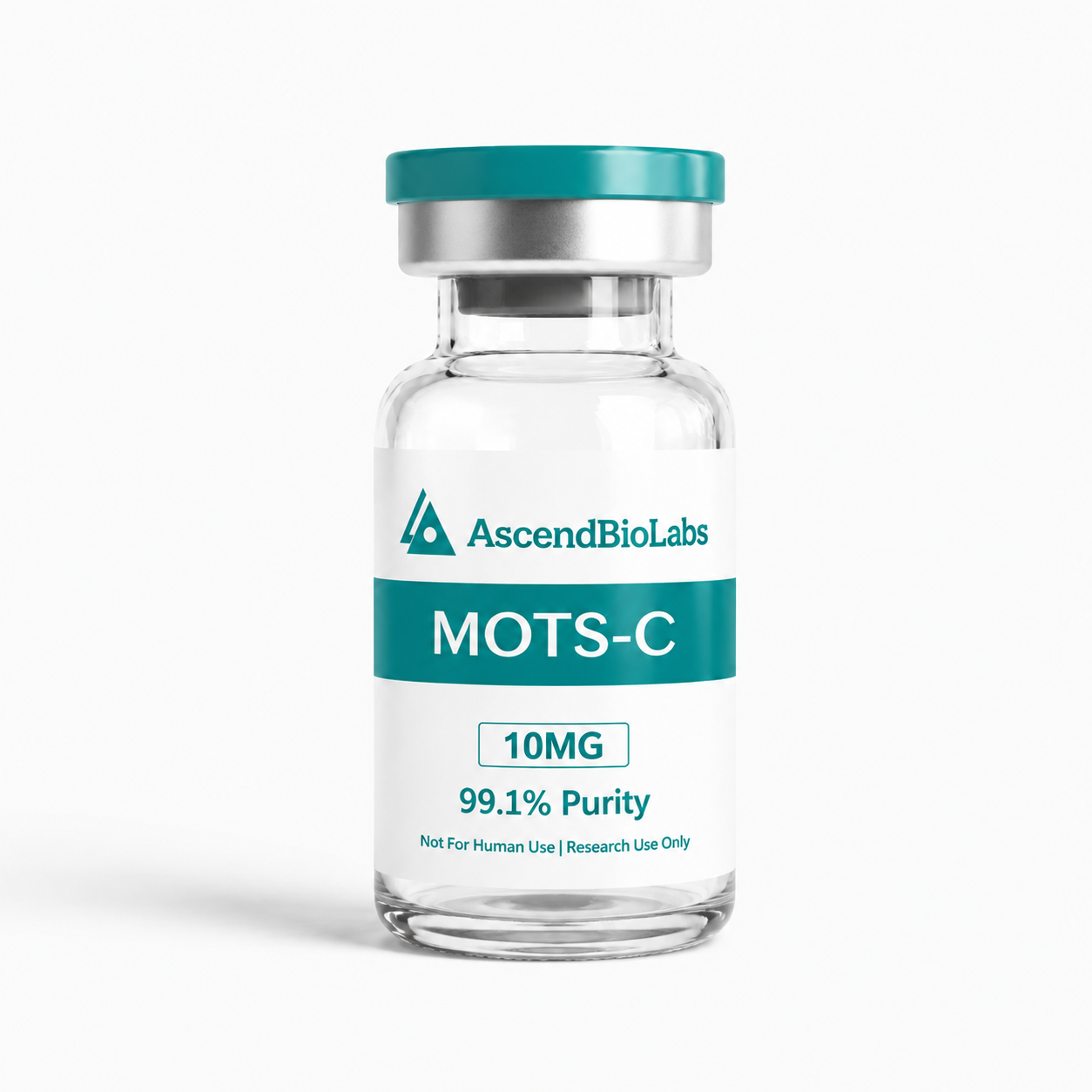
AvigenLab MOTS-c 10MG provides a clearly defined research-product configuration for the AvigenLab catalog. The product name, 10MG quantity, 99.1% purity designation, and research-use classification create straightforward reference points for product organization.
Related products
Description
MOTS-c 10MG
We provide MOTS-c as a 10MG mitochondrial-derived research peptide with a stated 99.1% purity. Furthermore, this 16-amino-acid peptide originates from a short open reading frame within the mitochondrial 12S rRNA region and has attracted substantial research interest because of its relationship with metabolic regulation, AMPK signaling, glucose utilization, and mitochondrial function.
Key Attributes
- Brand: AvigenLab
- Product Name: MOTS-c
- Quantity: 10MG
- Stated Purity: 99.1%
- Molecular Type: Mitochondrial-Derived Peptide
- Sequence Length: 16 Amino Acids
- Genetic Origin: Mitochondrial 12S rRNA region
- Product Format: Vial
- Classification: Research Use Only
- Human Use: Not For Human Use
MOTS-c Product Overview
We provide MOTS-c for research involving mitochondrial signaling, cellular metabolism, glucose regulation, energy homeostasis, and aging-related biology. Moreover, published research identifies the peptide as a mitochondrial-derived signaling molecule that can respond to metabolic stress and influence nuclear gene expression.
Additionally, research has connected the peptide with the folate-methionine cycle and de novo purine biosynthesis. Consequently, changes in these pathways can increase AICAR availability and contribute to AMPK activation, providing an important mechanism for studying metabolic adaptation.
You can explore additional research materials through our Online Store.
MOTS-c Product Identification
We identify MOTS-c as a 10MG mitochondrial-derived peptide with a stated 99.1% purity. Furthermore, scientific literature characterizes it as a 16-amino-acid peptide encoded within the 12S rRNA region of mitochondrial DNA.
Accordingly, its mitochondrial genetic origin, peptide length, quantity, and purity designation provide clear reference points for laboratory documentation and inventory management.
Product Category
We classify MOTS-c within our mitochondrial-derived research peptide collection. Accordingly, its scientific relevance extends across metabolic signaling, glucose utilization, mitochondrial biology, exercise-related metabolism, and aging research.
Moreover, researchers have investigated the peptide as a retrograde signaling molecule capable of influencing communication between mitochondria and the nucleus. Therefore, its research profile extends beyond conventional peptide biology into mitochondrial-nuclear signaling and cellular stress adaptation.
Scientific Characteristics
MOTS-c functions as a 16-amino-acid mitochondrial-derived peptide encoded by a short open reading frame within the mitochondrial 12S rRNA region. Unlike conventional nuclear-encoded proteins, its genetic origin places it within the growing group of mitochondrial-derived peptides that participate in cellular signaling.
Furthermore, studies indicate that metabolic stress can promote movement of the peptide toward the nucleus, where it can interact with transcriptional regulatory mechanisms. Meanwhile, AMPK, NRF2, SIRT1, and PGC-1α-related pathways have all received attention in research examining its biological activity.
Research Applications
We position MOTS-c for research involving AMPK signaling, glucose metabolism, mitochondrial function, metabolic stress, energy homeostasis, and aging biology.
Additionally, early experimental work found that the peptide increased glucose uptake and glycolytic activity while influencing folate and purine metabolism. Consequently, researchers have continued examining the AICAR-AMPK pathway as an important component of its metabolic signaling profile.
Likewise, research has investigated mitochondrial biogenesis and respiratory function through pathways involving PGC-1α and related metabolic regulators. However, findings can differ according to experimental model, tissue, and study conditions, so individual results require appropriate scientific context.
Product Configuration
We provide MOTS-c in a 10MG vial carrying a stated 99.1% purity designation. Therefore, the defined quantity and purity provide straightforward reference points for laboratory inventory, analytical documentation, and research-material organization.
Moreover, the vial presentation establishes a distinct catalog configuration. Accordingly, researchers can identify the material through its product name, peptide classification, quantity, purity, and research-use designation.
Product Features
MOTS-c features a clearly defined mitochondrial-derived peptide identity alongside a 10MG quantity and stated 99.1% purity. Additionally, the product label communicates Not For Human Use | Research Use Only, supporting clear differentiation within our research catalog.
Furthermore, the peptide’s biological research profile encompasses glucose utilization, fatty-acid metabolism, AMPK signaling, stress adaptation, and mitochondrial regulation. Consequently, researchers can investigate multiple interconnected pathways using a defined mitochondrial-derived peptide model.
Product Specifications
| Specification | Product Information |
|---|---|
| Brand | AvigenLab |
| Product Name | MOTS-c |
| Quantity | 10MG |
| Stated Purity | 99.1% |
| Molecular Type | Mitochondrial-Derived Peptide |
| Sequence Length | 16 Amino Acids |
| Genetic Origin | Mitochondrial 12S rRNA Region |
| Product Format | Vial |
| Research Classification | Research Use Only |
| Human Use Classification | Not For Human Use |
Intended Research Context
We identify MOTS-c as Research Use Only and Not For Human Use. Accordingly, our documentation focuses on laboratory investigation rather than therapeutic or consumer applications.
In particular, researchers can investigate the peptide within experimental systems examining mitochondrial signaling, glucose metabolism, AMPK activity, metabolic stress, and aging-associated cellular processes. Moreover, animal and cellular studies have reported changes involving insulin sensitivity, glucose utilization, mitochondrial pathways, and metabolic homeostasis.
Nevertheless, these findings primarily arise from experimental research models. Therefore, they should not be interpreted as established clinical outcomes or as evidence of approved therapeutic applications.
Packaging Information
We present the product in a clearly labeled 10MG vial featuring our AvigenLab product presentation. The packaging identifies the peptide, displays the 10MG quantity, and communicates the stated 99.1% Purity designation.
Additionally, the label communicates Not For Human Use | Research Use Only. Therefore, the packaging provides straightforward product identification while supporting consistent laboratory inventory and catalog organization.
Regulatory Information
We classify the product as Research Use Only and maintain the Not For Human Use designation throughout our product documentation. Accordingly, scientific publications describing mitochondrial-derived peptide research do not constitute regulatory approval for a particular product presentation.
Moreover, current literature continues to describe MOTS-c as an experimental research molecule, with ongoing investigations into its mechanisms, metabolic functions, and potential biological significance.
Storage and Handling
We recommend following the storage and handling conditions specified in the applicable AvigenLab product documentation. Because peptide stability can depend on formulation, packaging, environmental exposure, and other product-specific factors, we avoid assigning unsupported storage parameters.
Furthermore, researchers should maintain appropriate laboratory handling practices and follow the product-specific documentation associated with the material. Consequently, this approach supports consistent laboratory management without introducing assumptions about conditions that may vary between formulations.
Market Availability
Our 10MG presentation provides a clearly defined mitochondrial-derived research peptide within our product collection. The product name, quantity, 99.1% purity designation, peptide classification, vial format, and research-use designation create clear reference points for laboratory inventory.
Moreover, the scientific literature continues to examine mitochondrial-derived peptides as signaling molecules involved in metabolic adaptation and cellular homeostasis. Likewise, research into MOTS-c continues across metabolism, exercise biology, mitochondrial function, and aging-related research.
Product Reference
Our MOTS-c 10MG provides a defined 16-amino-acid mitochondrial-derived peptide with a stated 99.1% purity designation. We document the material according to its mitochondrial 12S rRNA origin, peptide classification, product configuration, research applications, and Research Use Only status.
Consequently, this product provides researchers with a clearly characterized material for investigating AMPK signaling, glucose utilization, mitochondrial biology, metabolic stress responses, and cellular energy regulation. Furthermore, continued research into mitochondrial-derived peptides is expanding understanding of how mitochondrial genetic elements can participate in broader cellular signaling networks.



Reviews
There are no reviews yet.