12k+ Research orders shipped.
99.3% Avg. verified purity.
38+ Compounds in catalog.
Built for the lab, not the shelf.

KPV
Our KPV 10MG presentation provides a defined synthetic tripeptide carrying a stated 99.1% purity designation. We document the material according to its Lys-Pro-Val sequence, molecular characteristics, vial configuration, inflammatory research relevance, and Research Use Only status.
Our KPV 10MG presentation provides a defined synthetic tripeptide carrying a stated 99.1% purity designation. We document the material according to its Lys-Pro-Val sequence, molecular characteristics, vial configuration, inflammatory research relevance, and Research Use Only status.
Related products
Description
KPV 10MG
We provide KPV as a 10MG synthetic tripeptide research compound with a stated 99.1% purity. Furthermore, KPV represents the C-terminal tripeptide sequence of α-MSH, consisting of lysine, proline, and valine. Consequently, researchers have investigated this peptide in relation to inflammatory signaling, NF-κB activity, cytokine regulation, gastrointestinal biology, and dermatological research. Scientific literature has specifically examined KPV in experimental models of intestinal and cutaneous inflammation.
Key Attributes — KPV
- Brand: AvigenLab
- Product Name: KPV
- Quantity: 10MG
- Stated Purity: 99.1%
- Molecular Type: Synthetic Tripeptide
- Sequence: Lys-Pro-Val
- Sequence Length: 3 Amino Acids
- Molecular Formula: C₁₆H₃₀N₄O₄
- Molecular Weight: 342.43 g/mol
- CAS Number: 67727-97-3
- Product Format: Vial
- Classification: Research Use Only
- Human Use: Not For Human Use
PubChem identifies the parent KPV structure as Lys-Pro-Val and reports a molecular weight of 342.43 g/mol.
KPV Product Overview
We provide KPV for research involving inflammatory signaling, NF-κB regulation, cytokine pathways, gastrointestinal biology, epithelial responses, and melanocortin-related research. Moreover, the peptide corresponds to residues 11–13 of α-MSH, a region that researchers have associated with much of the parent hormone’s anti-inflammatory activity.
Additionally, experimental studies have examined KPV in models of intestinal inflammation and reported changes in inflammatory infiltration, myeloperoxidase activity, and tissue responses. Therefore, the compound provides a defined molecular subject for investigating inflammation-related mechanisms under controlled experimental conditions.
Researchers can explore additional materials through our Online Store.
KPV Product Identification
We identify KPV through its 10MG quantity, stated 99.1% purity, three-amino-acid sequence, and vial presentation. Accordingly, the product provides clear reference points for laboratory inventory, molecular documentation, and research catalog organization.
Furthermore, PubChem identifies the sequence as Lys-Pro-Val, with the molecular formula C₁₆H₃₀N₄O₄ and molecular weight of 342.43 g/mol.
Product Category
We classify the material within our research peptide collection for inflammation, gastrointestinal biology, dermatological research, cellular signaling, and peptide mechanism studies.
Moreover, researchers have investigated the C-terminal region of α-MSH because it retains substantial anti-inflammatory activity despite lacking the full parent hormone sequence. Consequently, KPV has attracted research interest across experimental models involving epithelial, immune, and inflammatory responses.
Scientific Characteristics
KPV contains only three amino acids: lysine, proline, and valine. In particular, PubChem identifies the peptide as L-Lysyl-L-prolyl-L-valine, with a molecular formula of C₁₆H₃₀N₄O₄.
Furthermore, researchers have investigated mechanisms involving NF-κB and inflammatory mediator regulation. Nevertheless, the precise signaling mechanism of KPV remains an active area of research. Importantly, some studies indicate that KPV can produce anti-inflammatory effects independently of classical melanocortin receptor signaling, so we avoid presenting direct MC1R or MC3R binding as an established property of the peptide.
Research Applications — KPV
We position KPV for research involving NF-κB signaling, inflammatory cytokine regulation, intestinal inflammation, epithelial biology, dermatological mechanisms, and peptide-mediated cellular responses.
Additionally, studies have examined KPV in experimental colitis models, where researchers observed reduced inflammatory changes and improved tissue-related outcomes. Likewise, laboratory research has investigated its effects on NF-κB-dependent inflammatory signaling in epithelial and immune-cell systems.
Consequently, researchers can investigate the peptide across multiple experimental models while maintaining a clear distinction between preclinical observations and established clinical outcomes.
Product Configuration
We provide the material in a 10MG vial carrying a stated 99.1% purity designation. Furthermore, the defined quantity, molecular identity, purity specification, and physical presentation establish straightforward reference points for laboratory inventory.
Additionally, the individual-peptide configuration distinguishes this presentation from longer α-MSH-derived compounds and other peptide formulations. Therefore, researchers can organize the product according to its specific molecular identity, quantity, purity, and physical format.
Product Features — KPV
The primary features of KPV include a 10MG quantity, 99.1% stated purity, three-amino-acid sequence, and clearly defined research-use presentation. Moreover, our product label communicates Not For Human Use | Research Use Only.
Furthermore, its compact tripeptide structure makes it a useful molecular subject for research examining peptide-mediated inflammatory responses and signaling mechanisms. Consequently, the product provides a straightforward reference material for controlled laboratory investigations.
Product Specifications
| Specification | Product Information |
|---|---|
| Brand | AvigenLab |
| Product Name | KPV |
| Quantity | 10MG |
| Stated Purity | 99.1% |
| Molecular Type | Synthetic Tripeptide |
| Sequence | Lys-Pro-Val |
| Sequence Length | 3 Amino Acids |
| Molecular Formula | C₁₆H₃₀N₄O₄ |
| Molecular Weight | 342.43 g/mol |
| CAS Number | 67727-97-3 |
| Product Format | Vial |
| Research Classification | Research Use Only |
| Human Use Classification | Not For Human Use |
The molecular sequence, formula, molecular weight, and CAS number correspond with the KPV chemical identity recorded by PubChem.
Intended Research Context — KPV
We identify KPV as Research Use Only and Not For Human Use. Accordingly, our documentation focuses on laboratory investigation rather than therapeutic or consumer applications.
In particular, researchers can examine the peptide within experimental systems involving inflammatory signaling, intestinal epithelial responses, NF-κB activity, cytokine regulation, and melanocortin-derived peptide biology. Furthermore, published research has investigated the peptide in murine models of intestinal inflammation and cellular models of inflammatory signaling.
Nevertheless, findings from animal and cellular models do not automatically establish equivalent effects in humans. Therefore, researchers should interpret observations according to the experimental model, methodology, formulation, and measured endpoint.
Packaging Information
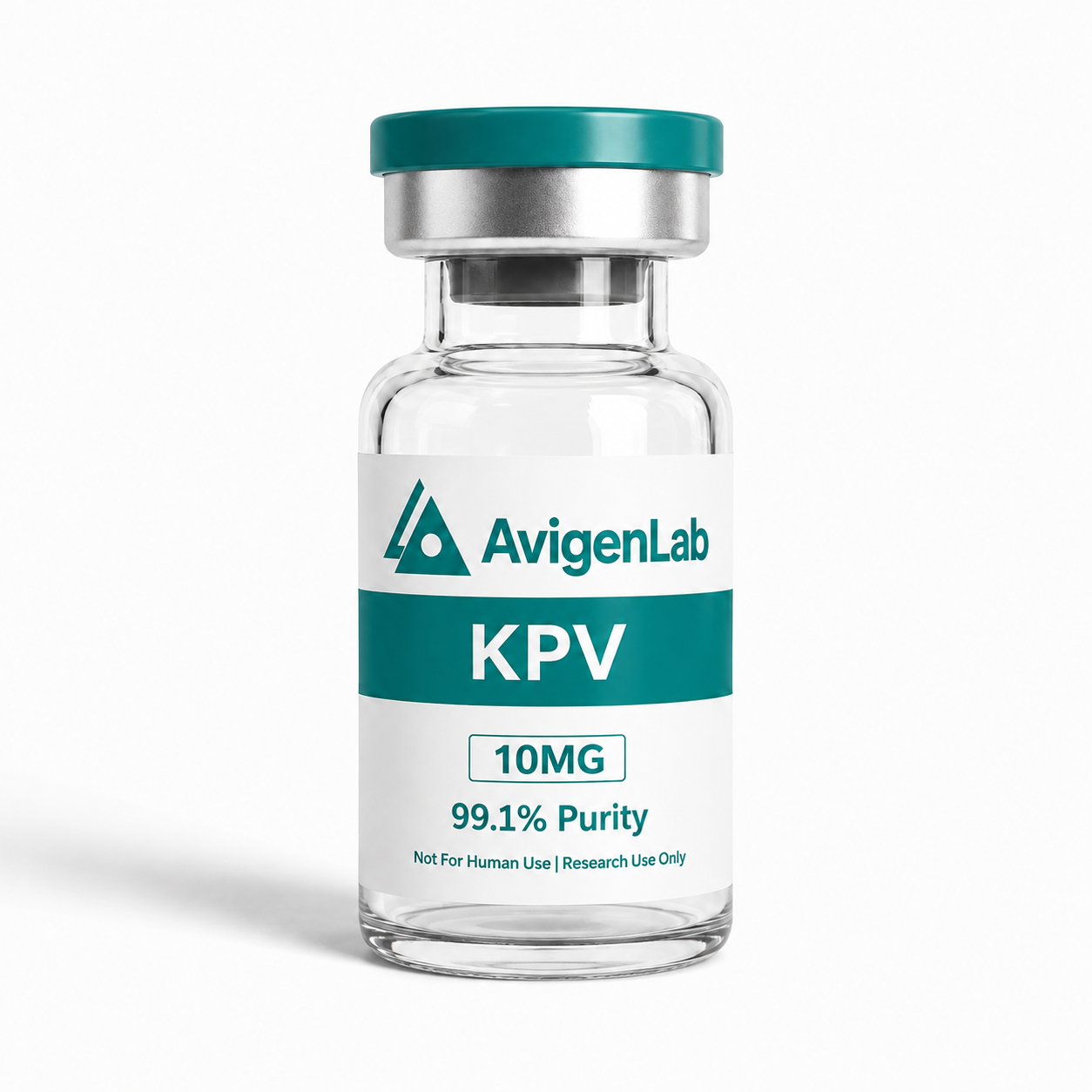
We present the product in a clearly labeled 10MG vial featuring our AvigenLab product presentation. The packaging displays the 10MG quantity, communicates the stated 99.1% Purity, and identifies the material as Not For Human Use | Research Use Only.
Additionally, the vial format provides straightforward identification within our research catalog. You can also explore related materials through our Catalog.
Regulatory Information
We classify the product as Research Use Only and maintain the Not For Human Use designation throughout our product documentation. Accordingly, scientific publications concerning KPV do not constitute regulatory approval for this specific AvigenLab research presentation.
Moreover, the published literature primarily describes experimental and preclinical investigations of KPV and related α-MSH peptides. Consequently, we document the material according to its molecular identity, research relevance, product specifications, and scientific literature without presenting experimental observations as established therapeutic outcomes.
Storage and Handling
We recommend following the storage and handling conditions specified in the applicable AvigenLab product documentation. Furthermore, researchers should maintain appropriate laboratory handling practices and follow product-specific documentation.
Because peptide stability can depend on formulation, packaging, environmental exposure, and other product-specific variables, we avoid assigning unsupported storage parameters. Consequently, this approach supports consistent laboratory management without introducing assumptions about conditions that may vary between formulations.
Market Availability — KPV
Our 10MG presentation provides a defined research peptide configuration within our collection. The quantity, stated purity, molecular identity, three-amino-acid sequence, vial format, and Research Use Only designation create clear reference points for laboratory inventory.
Moreover, KPV has an established research history within inflammation and peptide biology. Researchers have investigated it in gastrointestinal, epithelial, immune, and dermatological models, while studies continue to examine its signaling mechanisms and relationship with the inflammatory effects associated with α-MSH.
Product Reference
Our KPV 10MG presentation provides a defined synthetic tripeptide carrying a stated 99.1% purity designation. We document the material according to its Lys-Pro-Val sequence, molecular characteristics, vial configuration, inflammatory research relevance, and Research Use Only status.
Consequently, the product provides researchers with a clearly identified material for investigating NF-κB regulation, inflammatory signaling, intestinal biology, epithelial responses, and related peptide mechanisms. Furthermore, research indicates that the anti-inflammatory activity associated with KPV can involve mechanisms distinct from conventional melanocortin-receptor signaling, making its molecular behavior an important area for continued investigation.
For additional product information, researchers can also visit our Shop.



Reviews
There are no reviews yet.