12k+ Research orders shipped.
99.3% Avg. verified purity.
38+ Compounds in catalog.
Built for the lab, not the shelf.


Epithalon
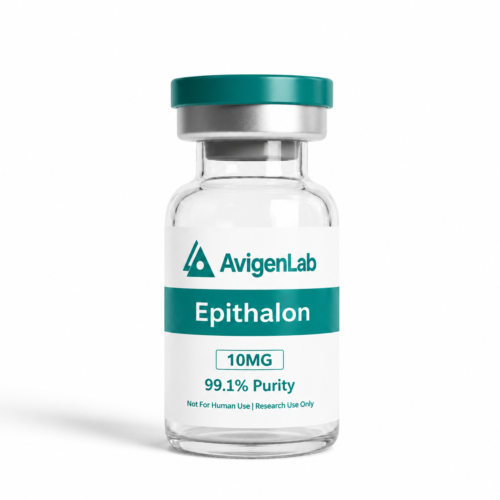
Our Epithalon 10MG is a research-use product presented in a 10MG vial with a stated 99.1% Purity designation. The product label additionally states Not For Human Use | Research Use Only, providing an important classification reference within our catalog.
Our Epithalon 10MG is a research-use product presented in a 10MG vial with a stated 99.1% Purity designation. The product label additionally states Not For Human Use | Research Use Only, providing an important classification reference within our catalog.
Related products
Description
H1 — Epithalon 10MG
We provide Epithalon as a synthetic tetrapeptide presented in a 10MG research vial with a stated 99.1% purity. Furthermore, Epithalon consists of the amino-acid sequence Ala-Glu-Asp-Gly (AEDG) and has attracted extensive research interest because of its relationship to pineal biology, telomerase activity, melatonin synthesis, and circadian regulation.
Key Attributes
- Brand: AvigenLab
- Product Name: Epithalon
- Quantity: 10MG
- Stated Purity: 99.1%
- Molecular Type: Synthetic tetrapeptide
- Sequence: Ala-Glu-Asp-Gly (AEDG)
- Sequence Length: 4 amino acids
- Product Format: Vial
- Classification: Research Use Only
- Human Use: Not For Human Use
Epithalon Product Overview
We provide Epithalon for research applications involving peptide biology, aging-related cellular processes, pineal signaling, and chronobiology. Moreover, Epithalon, also known as Epithalon or Epithalone in the literature, represents a four-amino-acid peptide developed from the amino-acid composition associated with Epithalamin, a pineal peptide preparation.
Research has examined Epithalon across in vitro, in vivo, and computational models, with particular attention to telomerase activity, telomere biology, melatonin production, neuroendocrine regulation, and circadian signaling. Consequently, the compound has become a recurring subject within gerontology and chronobiology research.
You can explore additional research materials through our Online Store.
Epithalon Product Identification
We identify this product as Epithalon 10MG, with a stated 99.1% purity and a four-residue sequence of Ala-Glu-Asp-Gly. Additionally, researchers may encounter the compound under the names Epithalon, Epithalone, or AEDG within scientific literature.
The short sequence distinguishes Epithalon from longer peptide structures while providing a clearly defined molecular identity for laboratory research and analytical reference.
Product Category
We classify Epithalon within our research peptide collection. Accordingly, its primary scientific identity comes from its tetrapeptide structure and its extensive investigation across cellular, animal, and biochemical research models.
Furthermore, researchers have investigated Epithalon in relation to pineal gland function, melatonin synthesis, circadian rhythms, telomerase, and cellular aging. A recent scientific review describes the compound as extensively studied through in vitro, in vivo, and in silico approaches while noting that its complete mechanisms of action remain unresolved.
Scientific Characteristics
Epithalon contains four amino acids arranged in the sequence Ala-Glu-Asp-Gly (AEDG). Therefore, researchers classify it as a tetrapeptide rather than a larger protein or polypeptide. The sequence represents alanine, glutamic acid, aspartic acid, and glycine connected through peptide bonds.
Moreover, research has associated Epithalon with several biological pathways. Studies have reported effects involving melatonin synthesis and telomerase activity, while other investigations have examined changes in gene expression and cellular responses. Nevertheless, researchers continue to investigate which molecular pathways account for its observed effects.
Research Applications
We position Epithalon as a research compound for investigating mechanisms associated with cellular aging, telomere biology, pineal function, melatonin regulation, and circadian signaling.
Research on human cell cultures has reported Epithalon-associated increases in telomerase catalytic activity and telomere length, while a more recent study examined hTERT expression and telomere changes across different human cell lines.
Likewise, animal research has examined Epithalon in relation to pineal melatonin production and circadian regulation. Studies in aged rhesus monkeys reported changes in melatonin synthesis following Epithalon administration, providing a research basis for continued investigation of pineal and circadian biology.
Product Configuration
We provide Epithalon in a 10MG vial with a stated 99.1% purity. Additionally, the product configuration provides a defined research-peptide quantity for laboratory inventory, analytical work, and controlled experimental environments.
The four-residue sequence gives researchers an additional identification parameter alongside the product name, quantity, and purity designation. Consequently, the combination of molecular identity and product configuration supports consistent catalog and laboratory reference.
Product Features
Epithalon combines a defined AEDG tetrapeptide sequence with a 10MG product presentation and stated 99.1% purity. Moreover, its research profile encompasses multiple areas of biological investigation rather than a single experimental pathway.
Research has explored its relationship with telomerase, telomere maintenance, melatonin synthesis, circadian gene expression, oxidative processes, and neuroendocrine regulation.
Importantly, these findings come from different experimental models and should therefore remain within their appropriate scientific context rather than being presented as established clinical outcomes.
Product Specifications
| Specification | Product Information |
|---|---|
| Brand | AvigenLab |
| Product Name | Epithalon |
| Quantity | 10MG |
| Stated Purity | 99.1% |
| Molecular Type | Synthetic Tetrapeptide |
| Sequence | Ala-Glu-Asp-Gly (AEDG) |
| Sequence Length | 4 Amino Acids |
| Product Format | Vial |
| Research Classification | Research Use Only |
| Human Use Classification | Not For Human Use |
Intended Research Context
We identify Epithalon as Research Use Only and Not For Human Use. Accordingly, our product documentation focuses on laboratory investigation rather than therapeutic or consumer applications.
Researchers can investigate Epithalon within appropriate experimental systems involving peptide biology, cellular aging, telomere-associated processes, pineal signaling, and circadian mechanisms. Furthermore, published research includes cellular and animal studies examining these areas, while the overall evidence base continues to develop.
Packaging Information
We present Epithalon in a clearly labeled 10MG vial featuring our AvigenLab branding. The packaging identifies the product as Epithalon and displays the stated 10MG quantity and 99.1% Purity designation.
Additionally, the label communicates Not For Human Use | Research Use Only. Therefore, the packaging provides clear product-identification information alongside the molecular and research characteristics documented for the compound.
Regulatory Information
We classify Epithalon as Research Use Only and maintain the Not For Human Use designation throughout our product documentation.
Moreover, research publications should not be interpreted as evidence of regulatory approval or established clinical use. The scientific literature describes experimental findings across different models, and current research continues to investigate Epithalon’s mechanisms and biological effects.
Storage and Handling
We recommend following the storage and handling conditions provided with the specific AvigenLab product documentation. Because peptide stability can depend on formulation, packaging, environmental exposure, and other product-specific factors, we avoid assigning unsupported storage parameters.
Accordingly, researchers should maintain appropriate laboratory handling practices and follow the product-specific documentation supplied with the material.
Market Availability
Our Epithalon 10MG provides a defined research-peptide configuration within our product collection. The product name, four-amino-acid sequence, 10MG quantity, 99.1% purity designation, vial format, and research classification create clear reference points for laboratory inventory.
Furthermore, its established presence in research literature makes Epithalon readily identifiable across studies involving gerontology, pineal biology, circadian research, and cellular aging.
Product Reference
Our Epithalon 10MG is a synthetic tetrapeptide consisting of Ala-Glu-Asp-Gly (AEDG) and carrying a stated 99.1% purity designation. We provide the compound in a 10MG vial for research use, with the product documentation clearly identifying its research-only classification.
Consequently, Our product offers researchers a defined peptide material for investigating areas including telomerase activity, telomere biology, pineal signaling, melatonin synthesis, and circadian regulation. Published research continues to explore these mechanisms across cellular and animal models, making Our Product an established subject within experimental aging and chronobiology research.



Reviews
There are no reviews yet.