12k+ Research orders shipped.
99.3% Avg. verified purity.
38+ Compounds in catalog.
Built for the lab, not the shelf.


L-Carnitine
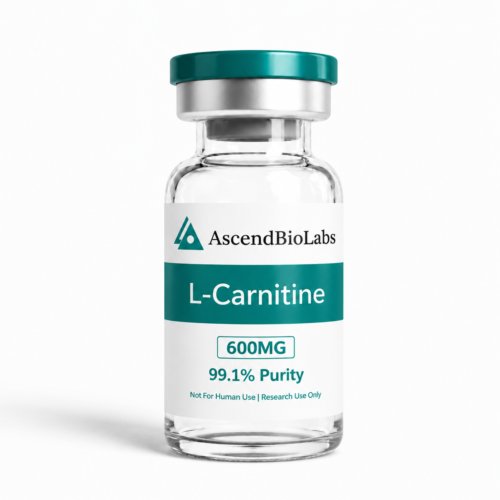
Our L-Carnitine 600MG is a research-use product presented in a 600MG vial with a stated 99.1% Purity designation. The product label additionally states Not For Human Use | Research Use Only, providing an important classification reference within our catalog.
Our L-Carnitine 600MG is a research-use product presented in a 600MG vial with a stated 99.1% Purity designation. The product label additionally states Not For Human Use | Research Use Only, providing an important classification reference within our catalog.
Related products
Description
L-Carnitine 600MG
We provide L-Carnitine as a research compound in a 600MG vial with a stated 99.1% purity. Furthermore, this naturally occurring quaternary ammonium compound plays a central role in cellular fatty-acid metabolism by facilitating the transport of long-chain fatty acids into mitochondria for β-oxidation.
Key Attributes
- Brand: AvigenLab
- Product Name: L-Carnitine
- Quantity: 600MG
- Stated Purity: 99.1%
- Molecular Type: Quaternary ammonium compound
- Molecular Formula: C₇H₁₅NO₃
- Product Format: Vial
- Research Classification: Research Use Only
- Human Use Classification: Not For Human Use
Product Overview
We provide L-Carnitine for research involving mitochondrial metabolism, fatty-acid oxidation, energy metabolism, metabolic flexibility, and related biochemical pathways. Moreover, the compound functions as a carrier for activated long-chain fatty acids, allowing these substrates to cross the inner mitochondrial membrane and reach the mitochondrial matrix for β-oxidation.
Beyond fatty-acid transport, researchers continue to investigate carnitine and acylcarnitine metabolism in relation to mitochondrial homeostasis, acetyl-CoA regulation, cellular signaling, inflammation, and other metabolic processes.
You can explore additional research materials through our Online Store.
Product Identification
We identify this material as L-Carnitine 600MG, with a stated 99.1% purity and a clearly defined vial presentation. Additionally, L-carnitine occurs naturally in mammalian tissues and derives from both endogenous biosynthesis and dietary sources. Its biosynthesis uses lysine as the carbon backbone and methionine as a methyl-group donor through a multistep enzymatic pathway.
Product Category
We classify L-Carnitine within our research compounds for metabolic and mitochondrial studies. Accordingly, its primary scientific importance comes from its participation in the carnitine shuttle, which coordinates the movement of long-chain fatty acyl groups into mitochondria.
Furthermore, researchers study this pathway because mitochondrial β-oxidation generates acetyl-CoA, NADH, and FADH₂, which contribute to cellular energy production.
Scientific Characteristics
L-Carnitine has the molecular formula C₇H₁₅NO₃ and functions as a water-soluble quaternary ammonium compound. Its metabolic role extends beyond simply transporting fatty acids because carnitine also participates in the regulation of cellular acyl-CoA and CoA pools.
The carnitine shuttle involves several coordinated components, including carnitine palmitoyltransferase I, carnitine-acylcarnitine translocase, and carnitine palmitoyltransferase II. Together, these components transfer long-chain acyl groups into the mitochondrial matrix while recycling free carnitine for continued transport.
Research Applications
We position L-Carnitine for research involving fatty-acid oxidation, mitochondrial function, metabolic flexibility, energy metabolism, and acyl-CoA regulation. Researchers can examine its role within the carnitine shuttle and its relationship with mitochondrial substrate utilization.
Moreover, research increasingly examines the broader carnitine pool rather than focusing exclusively on fatty-acid transport. Current literature explores relationships between carnitine metabolism, mitochondrial homeostasis, inflammatory signaling, immune regulation, epigenetic processes, and cellular communication.
Product Configuration
We provide the compound in a 600MG vial carrying a stated 99.1% purity designation. This defined quantity creates a clear reference point for laboratory inventory, analytical documentation, and research-material organization.
Additionally, the vial presentation separates this material from other configurations that may use different quantities or physical formats. Consequently, researchers can reference the product according to its specific quantity, purity designation, and research classification.
Product Features
The primary feature of our L-Carnitine presentation is its defined 600MG quantity and stated 99.1% purity. Moreover, the compound’s established biochemical role gives researchers a clearly characterized material for investigating mitochondrial fatty-acid transport and related metabolic pathways.
Research also recognizes carnitine as a regulator of acyl-group balance. By accepting acyl groups from acyl-CoA molecules, carnitine can help maintain the availability of free CoA while supporting the movement of acyl groups between cellular compartments.
Product Specifications
| Specification | Product Information |
|---|---|
| Brand | AvigenLab |
| Product Name | L-Carnitine |
| Quantity | 600MG |
| Stated Purity | 99.1% |
| Molecular Type | Quaternary Ammonium Compound |
| Molecular Formula | C₇H₁₅NO₃ |
| Product Format | Vial |
| Research Classification | Research Use Only |
| Human Use Classification | Not For Human Use |
Intended Research Context
We identify this material as Research Use Only and Not For Human Use. Accordingly, our product documentation focuses on laboratory investigation rather than therapeutic or consumer applications.
Researchers can examine the compound within appropriate experimental systems involving mitochondrial metabolism, fatty-acid transport, β-oxidation, acetyl-CoA balance, and metabolic regulation. Furthermore, research into carnitine transport and metabolism provides important insight into how cells coordinate lipid utilization with mitochondrial energy production.
Packaging Information
We present the product in a clearly labeled 600MG vial featuring our AvigenLab branding. The packaging identifies the compound, displays the 600MG quantity, and communicates the stated 99.1% Purity designation.
Additionally, the label communicates Not For Human Use | Research Use Only. Therefore, the packaging provides clear identification alongside the scientific and catalog information associated with the material.
Regulatory Information
We classify the product as Research Use Only and maintain the Not For Human Use designation throughout our product documentation. Accordingly, scientific literature describing carnitine biology should not be interpreted as regulatory approval for a specific AvigenLab product.
Instead, our documentation focuses on established biochemical characteristics, research applications, product specifications, and the appropriate research classification.
Storage and Handling
We recommend following the storage and handling conditions specified in the applicable AvigenLab product documentation. Because compound stability can depend on formulation, packaging, environmental exposure, and other product-specific factors, we avoid assigning unsupported storage parameters.
Nevertheless, researchers should maintain appropriate laboratory handling practices and follow the product-specific documentation associated with the material.
Market Availability
Our 600MG presentation provides a clearly defined research configuration within our product collection. The product name, quantity, 99.1% purity designation, vial format, and research classification create straightforward reference points for laboratory inventory and catalog organization.
Furthermore, the compound’s established role in mitochondrial fatty-acid transport makes it a recognizable research material across metabolic and biochemical research.
Product Reference
Our L-Carnitine 600MG is a research compound presented in a 600MG vial with a stated 99.1% purity designation. We document the material according to its defined molecular identity, metabolic characteristics, product configuration, and Research Use Only classification.
Consequently, this product provides researchers with a clearly characterized material for investigating the carnitine shuttle, long-chain fatty-acid transport, mitochondrial β-oxidation, acetyl-CoA regulation, and broader metabolic processes. Current research continues to expand understanding of carnitine’s functions beyond its traditional role in fatty-acid oxidation.



Reviews
There are no reviews yet.